
Image: SOS Children’s Villages Spain
Recently, SOS Children’s Villages Spain renewed its KCS Level 1 Certification. For this article, we spoke with Concha Maldonado Calvo, National Child Safeguarding Focal Point and Maria del Mar Líndez Líndez, member of the Management group. Both shared how the audit and certification process not only strengthened good practices among staff but also allowed for the integration of protection guidelines in all areas and promoted the active participation of children in the development of institutional policies.
SOS Children’s Villages specialises in providing family support and foster homes for children and teenagers. They also organise family strengthening programmes and work on initiatives to prevent more children from being separated from their families.
Why do certification?
A large number of children come into contact with the organisation through its many activities. That is why SOS Children’s Villages in Spain has always worked with a strong focus on Child Safeguarding. However, after the global SOS Children’s Villages Federation updated its child safeguarding policy in collaboration with KCS, the Spanish team identified areas for improvement in the way they worked.
‘It is very valuable that someone from outside the organisation – and with knowledge of KCS – was able to confirm that we were doing things correctly. It is a good guarantee that someone outside the organisation verifies the processes,’ said Concha Maldonado Calvo, National Child Safeguarding Focal Point.
Reinforcing the staff’s commitment and confidence
The KCS audit and certification process – promoted by the SOS management – involved staff from various areas, sparking a renewed commitment to child safeguarding throughout the organisation. Employees from areas that are not usually associated with safeguarding but who do have a responsibility, became more involved and noticed that their work was highly valued, committing themselves even more than before to child safeguarding practices. From the management team to tutors and maintenance staff, everyone participated in the interviews and received guidance.
Promoting child participation
One of the greatest achievements of the process was to enhance child participation. The organisation always worked to put children and teenagers at the centre of their work, promoting activities to raise awareness, peer-learning and other dynamics, mainly within the framework of key dates such as the International Day Against Child Abuse and the International Day of the Rights of the Child.
‘We place a strong emphasis on collaborative processes involving children: although these may be slower, the results are more comprehensive. Preparing workshops that involve children is now part of the planning process for all our activities,’ stated representatives from SOS Children’s Villages Spain.
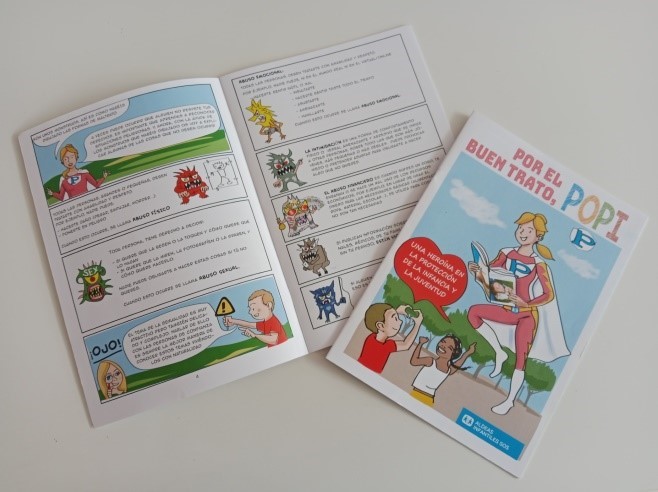
In line with this approach and motivated by the work carried out during the certification process, the SOS Children’s Villages Spain team launched a new project where they explored child safeguarding concepts with children. From these workshops emerged POPI, a superheroine on the subject, created by the kids of the project. Through this experience, children gained a deeper understanding of what child safeguarding entails, their rights and the behaviours expected of the adults who accompany them and other children.
‘It is a success when I visit a programme and children explain their rights and our organisation’s child safeguarding policies to me. It is great to see that they have learned so much and are able to explain these concepts.’ said the Deputy Director General of SOS Children’s Villages Spain.
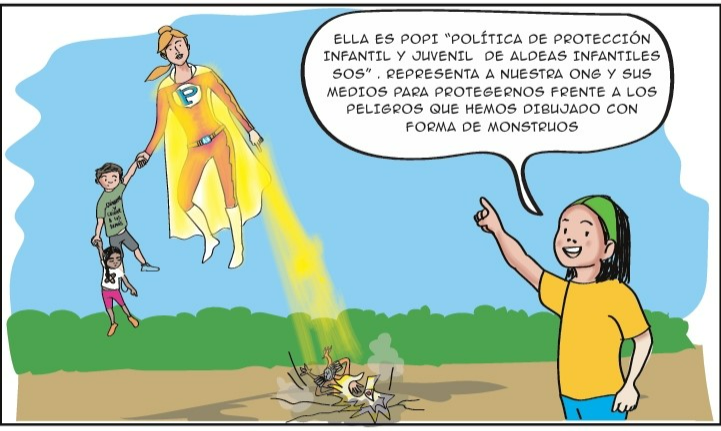
Image: SOS Children’s Villages Spain
Organising and integrating institutional practices
The KCS Certification process has also been beneficial for the organisation because, although child protection has always been one of its priorities, some good practices needed to be organised in order to integrate them across all its work.
Today, SOS Children’s Villages in Spain has a structure of regional child safeguarding committees and has incorporated training for children so that they themselves can also be agents for safeguarding. In addition, they have included child safeguarding issues as a topic in other workshops.
They have also reinforced staff training about the organisation’s child safeguarding policy and other related topics such as Trauma Informed Approach. They have also aligned their training with the national SOS Children’s Villages Training School.
From the perspective of SOS Children’s Villages in Spain, the certification has been a thorough and supportive process that has brought positive results in the way the organisation works. Representatives of the organisation also highlight that the support has gone beyond certification, as being part of the KCS network means they are in contact with new resources and knowledge-sharing activities.
About SOS Children’s Villages Spain
The organisation has a global reach and its Spanish branch is present in 11 of the country’s autonomous communities, which represent 65% of the national territory. Naturally, each community has its own regulations and practices, so the teams work in coordination but with specific characteristics in each context. They assist more than 29,759 children, teenagers and young people who have lost parental support or are at risk of losing it.